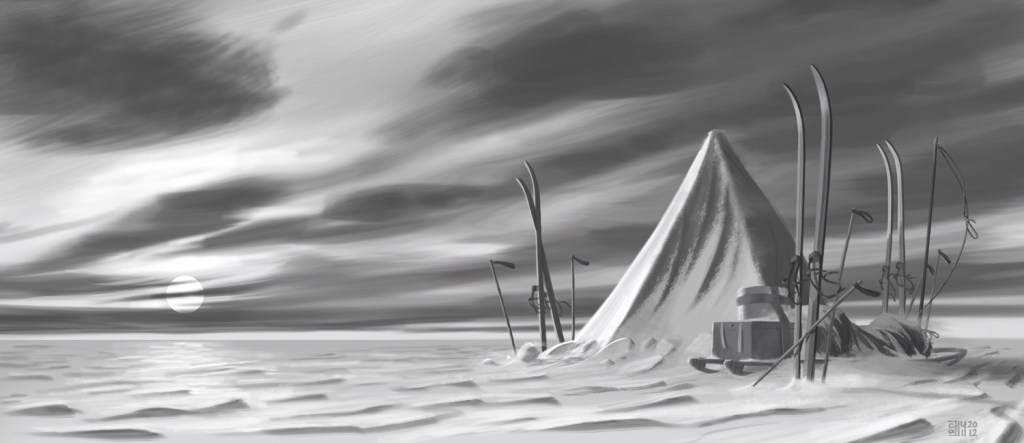
Originally posted on Patreon, 29 March 2022
And so the Earth completes another circuit of the sun, and once again we’re back at the High Holy Day of the Terra Nova calendar.
March 29th, 1912 is the last entry in Scott’s diary, and since he was pretty much the only one still writing at that point, it’s the day we mark the demise of the Polar Party, and by extension the rest of the Expedition. Just as the Endurance is most famous for sinking, Scott is most famous for dying – in fact, to a large extent, that’s all most people know about him and his companions, if they know anything at all.
This limited perspective means that endless gallons of ink have been spilled on analysis of the machinery of their demise – what went wrong and why, whose fault, which decision should have been taken and where – in which the people involved are just cogs, or pieces on a chessboard, who apparently sprang into existence only to dance this little dance and expire.
If I succeed in anything with this project, I hope it’s bringing them back into the collective consciousness as people, who lived and moved and had their being, loved and were loved, ate and slept and joked and felt and wept. Yes, they died, but they were also alive, and when they die it matters because we’ve lost them, not to demonstrate some strategic point.
As much as we might revel in their lives, the story does, ultimately, come down to their deaths. The most compelling question of how they died is not what caused them to die, but the manner in which they met their end; how the string of causality interacted with who they were as people to play out as it did, and how they faced it. One cannot critique the clockwork of the plot without also understanding the characters acting within and upon it.
It’s the tragedy that draws people in, of course. It’s the first thing most people learn about the story, and it’s the emotional hook that encourages one to find out more about the Expedition and the men involved. One discovers them in a sort of reverse biography: death, Expedition story, life story. Even as they come alive again in our heads, we know how they will die; it’s like a hovering cloud, sometimes out of sight but always casting a shadow. There’s no way to avoid that final destination. But then, isn’t that true of all of us? Playwright David Edgar said* that Shakespeare’s comedies teach us how to love, and his tragedies teach us how to die – surely that’s the draw of tragedy? Emotional catharsis, yes, but also a chance to explore how (or how not) to meet our fate? And this tragedy has meant so much to so many people through the years. Cherry wrote movingly about the many letters he’d received from people who found strength from the story to go through their own difficulties or face their own ends. It’s a story that lives on because it gives us something we need.
I’ve been so immersed in the early part of the story these last few years that I’ve hardly acknowledged March 29th. I suppose, in a way, it feels like jumping ahead. Nevertheless it’s always present, hovering out of sight like that cloud, as what I’m working towards. In the sense that we discover them living in reverse, I am writing them in reverse, putting a lot of work into arriving, satisfactorily, at the point where everyone starts: March 29th, 1912. For now, it’s all about the living. But I only started doing this because of the end, and ultimately it’s all about the end. The end shows us the way.
Obviously the Polar Party, and their families, friends, and colleagues, would have preferred them to live in relative obscurity than be promoted to glory, however affecting and/or inspirational. But now, 110 years later, everyone on the Terra Nova Expedition is equally dead, however they got there. It’s only the Polar Party who have achieved a kind of immortality – not just remembered, but loved and felt for. If a man is not dead while his name is yet spoken, how much more so those who inspire songs and plays and graphic novels, generations after they’ve gone?
*Simon Schama’s Shakespeare, episode 2
 The Worst Journey in the World: Graphic Novel
2 responses to “March 29th”
“Yes, they died, but they were also alive, and when they die it matters because we’ve lost them, not to demonstrate some strategic point.” I think that is very apt and it’s why I have enjoyed your story so much so far.
LikeLike
This is precisely what your book did for me. Up until that point, they were just names: Bowers, Wilson, Evans. Even during my time serving with the US Antarctic Program. Just names. But now, watching them go southbound with such vigor and determination, I find myself mourning – no, not Birdie! Not Uncle Bill! Thank you for bringing the memory of them alive to us all.
-dpc (South Pole Station 2010-2011, NBP 2014-2017)
LikeLike